Group Safaris in Kenya
Travel with the people you already know, or join a scheduled departure and meet them on the way. NLS Safaris plans both, with clear routes, rooming, vehicles and costs before anyone pays.

A Kenya group safari can mean two very different holidays. A private existing group controls its route and daily rhythm. A group-joining safari follows advertised dates and shares a vehicle with unrelated travellers.
Neither is automatically better. A couple travelling alone may value the social side and lower vehicle share of a scheduled departure. A family with children, a company retreat or six friends carrying cameras may gain more from a private vehicle. This website is owned by NLS Safaris and helps you understand that choice before the enquiry reaches the NLS planning team.
Private group safari or scheduled group joining safari?
| Decision | Private existing group | Group joining departure |
|---|---|---|
| Who travels together | Your invited family, friends, colleagues, club or association | Individuals and couples who reserve seats on the same departure |
| Dates | Chosen around the group’s flights and availability | Fixed by the advertised departure |
| Route and lodges | Selected for the group, subject to availability and budget | Specified in the departure details |
| Daily pace | Flexible within park rules, road safety and booked services | Shared with the other passengers |
| Vehicle cost | Divided across the people in your party | Divided across booked passengers, subject to confirmation rules |
| Rooming | Built from the group’s room list | Twin sharing or a single supplement under the departure terms |
| Best fit | Families, friends, photography groups, corporate teams and travellers with specific needs | Solo travellers, couples and friends happy with fixed arrangements |
Read the group joining safaris in Kenya page when price sharing and company matter most. Use the private group safari Kenya page when your party needs control over rooms, vehicles and route. The comparison should use the same season, parks and accommodation level. A cheaper trip created by dropping a park or changing the lodge is not a saving on the same safari.
Different groups need different safaris
Families and several generations
Children, parents and grandparents may need family rooms, ground-floor access, child restraints, earlier dinners and shorter drives. A private vehicle lets one branch rest while another takes a longer drive. The room plan matters as much as the park list.
Friends and celebration groups
Birthdays, reunions and graduation trips often need a mixture of twins, doubles and singles. Agree early whether everyone pays the same common amount or whether room upgrades and optional activities sit with the individual traveller.
Corporate teams and incentives
A corporate safari in Kenya may include arrival waves, invoices, meeting space, branded welcome items, a private dinner or a conference extension. The agenda must leave time for the wildlife experience rather than treating the safari as transport between meetings.
Schools, churches and associations
Large organised groups need an adult-to-student plan, dietary records, safeguarding, room allocation, convoy leadership and a realistic attendance deadline. A coach may handle transfers while separate safari vehicles operate wildlife drives.
Photography and birding groups
Fewer passengers per vehicle create room for lenses and movement. A photographer may want dawn departures and patient sightings; a birder needs window access and a guide who will stop for smaller subjects. Vehicle capacity should follow the purpose.
Solo travellers joining a departure
A scheduled group can provide company and divide vehicle costs. The bedroom is a separate choice. Ask whether twin sharing is matched, whether a single room is guaranteed and what supplement applies to the requested season.
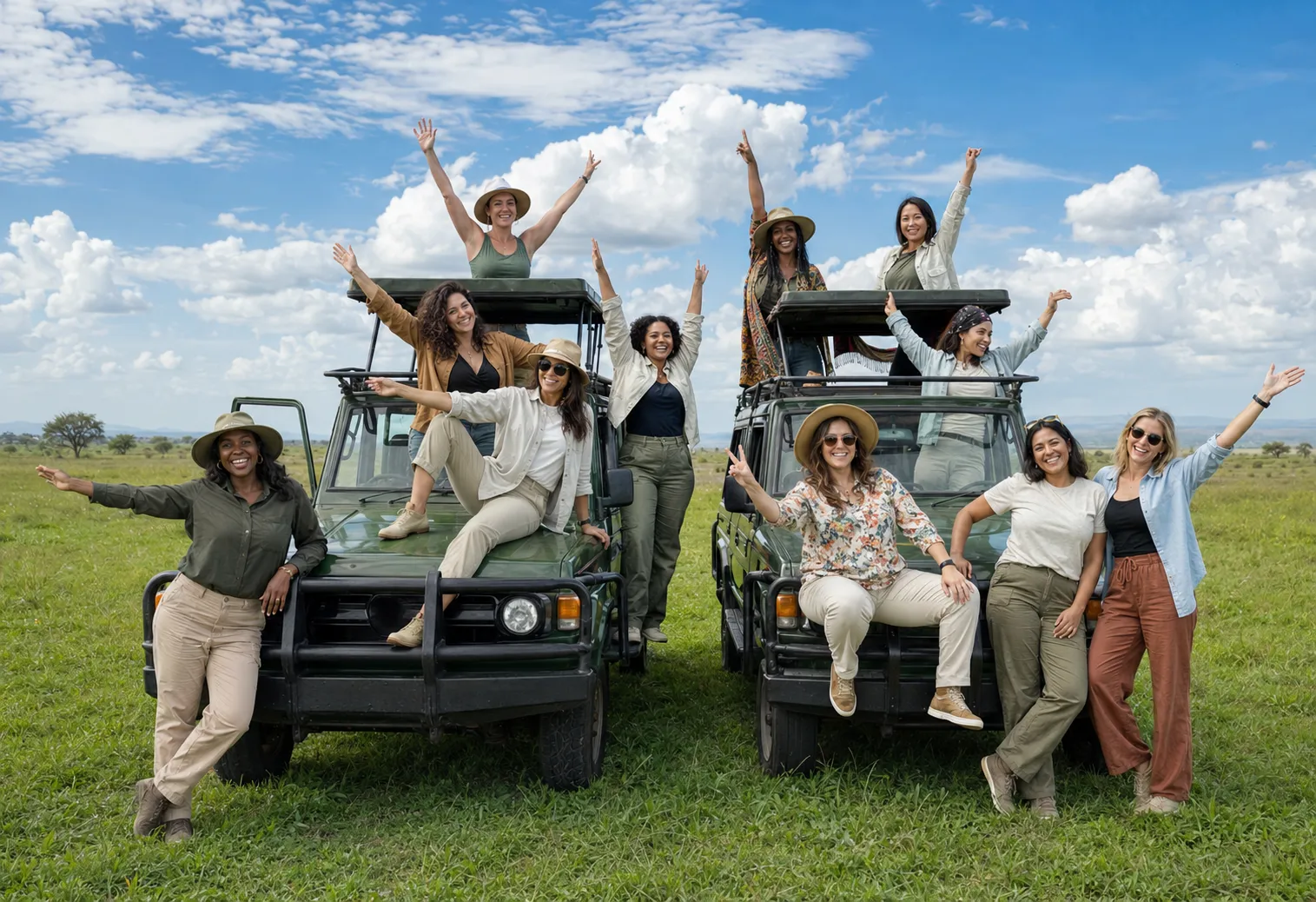
Kenya routes that make sense for groups
| Route idea | Useful duration | Why a group may choose it | Main trade-off |
|---|---|---|---|
| Masai Mara | 3 to 4 days from Nairobi | Big-cat country, open plains and a direct first-safari focus | The road transfer occupies much of arrival and departure day |
| Masai Mara and Lake Nakuru | 4 to 5 days | Adds rhino habitat, lake and escarpment scenery | More checkout and road time than a single-base Mara trip |
| Mara, Nakuru, Naivasha and Amboseli | 7 to 10 days | Combines major wildlife areas with a boat, walk or slower lake day | The seven-day version is brisk; the 10-day Kenya group safari gives each end of the route more time |
| Samburu, Ol Pejeta and Mara | 7 to 9 days | Northern species, rhino conservation and contrasting dry-country landscape | Longer road sectors or added flight cost |
| Amboseli and Tsavo to the coast | 6 to 9 days plus beach | Elephants, volcanic scenery and a natural finish in Diani, Mombasa or Watamu | Rail, road or flight handovers and coastal baggage need coordination |
| Nairobi National Park | Half or full day | Conference extension, layover or first wildlife day close to the capital | It is not a substitute for the scale and overnight rhythm of a longer circuit |
The right route protects full wildlife days. A three-night stay usually creates only two complete days between check-in and check-out. Large groups also move more slowly at breakfast, comfort stops and room allocation. Add time rather than assuming twenty people will transfer as quickly as two.
How many days should a Kenya group safari last?
Three to four days
Choose one main wildlife area or a tightly connected pair. A three-day Mara trip gives an arrival drive, one full day and a departure morning. It works for a short break, but flight delays and slow road conditions have little room.
Five to seven days
Two or three bases become possible. NLS currently publishes a five-day mid-range Mara, Lake Nakuru and Amboseli private safari from USD 1,868 per person sharing, and a seven-day mid-range circuit including Naivasha from USD 2,400 per person sharing. These are current starting anchors, not universal group prices.
Eight to ten days
A longer route can spend three nights in the Mara and Amboseli, with the Rift Valley lakes between them. It suits first-time visitors who do not want every second morning to begin with luggage outside the room.
Safari and beach
Allow enough beach nights to justify the transfer. A single coast night after a long Tsavo drive is rarely restful. Three or four nights gives the group time to arrive, enjoy the ocean and handle different return flights.
What changes the group safari cost?
A group price combines costs that are per person, per room, per vehicle and per booking. Park fees follow the traveller’s citizen, resident or non-resident category. Accommodation follows room occupancy and season. A safari vehicle and guide are largely fixed costs until another vehicle is needed.
| Cost | Charged mainly by | Group implication |
|---|---|---|
| Park and reserve fees | Visitor category and chargeable day | Mixed citizen, resident and non-resident groups should be itemised rather than averaged |
| Accommodation | Room, occupancy and season | Singles, family rooms and upgrades change individual totals |
| Vehicle and guide | Vehicle and route | Per-person share falls as occupancy grows, then rises when the group crosses into a second vehicle |
| Activities | Participant | Balloon flights, village visits and some Naivasha activities can stay optional |
| Transfers and flights | Vehicle, seat and baggage | Arrival waves, domestic flights and coast connections need their own lines |
Current official fee anchors show why the dates matter. Masai Mara lists a non-resident adult fee of USD 100 per day from January through June 2026 and USD 200 from July through December. The current KWS schedule lists non-resident adult conservation fees of USD 90 per day for Amboseli and Lake Nakuru, with different citizen and resident rates. Fees can change, so the written proposal should state the schedule used.
Use the Kenya safari operator comparison guide to place quotations side by side. The most useful quotation shows room basis, vehicle count, park days, meals, optional items and what changes if the final passenger number falls.
Passenger count is not the same as viewing comfort
Ask how many people occupy each row, who reaches the pop-up roof and where luggage travels. Six relatives may be comfortable in one extended Land Cruiser. Six photographers with long lenses may want two vehicles. Eight friends often enjoy two coordinated vehicles more than a body filled to its last possible seat.
For a large party, a coach can handle airport or conference transfers while safari vehicles take over in the parks. Two vehicles should have a lead guide, a communication method and agreed meeting points. Read the Kenya group safari vehicle seating guide before accepting a description such as “seven seater” without an interior photograph.
Twins, doubles, singles and family rooms
Start with names and relationships, not only a headcount. A group of twelve might need six twins, three doubles and six singles, or two family rooms plus four doubles. Those arrangements use a different number of rooms and will not have the same price.
Twin sharing means two separate beds in one room. A double has one bed intended for two people. A triple may be three proper beds, a double plus an extra bed, or a property-specific family arrangement. Never assume three adults will find every triple comfortable. A single supplement is the extra amount paid when one person occupies a room priced on two-person use. The Kenya safari single supplement guide explains when it applies and what to confirm.
Migration, rain, room blocks and school calendars
January to February
Often warm with useful dry periods, resident wildlife and fewer migration crowds. It can suit groups seeking value, though weather is never guaranteed.
March to May
Long-rain conditions can bring green landscapes and lower demand. Road conditions and showers need a capable vehicle and flexible expectations.
June to October
Popular dry-season travel and migration interest increase demand in the Mara. Large matching room blocks should be requested early.
November to December
Short rains refresh the scenery. Festive dates behave like their own high season, while other weeks can offer quieter parks.
The best time for a Kenya group safari post compares months by room availability, fees, crowding and group lead time rather than declaring one universal winner.
How NLS plans a group safari
Define the group
Send minimum and expected numbers, child ages, visitor categories, room preferences, dates, flights, budget and the reason for travelling.
Choose private or shared
NLS matches the party to a custom private route or a suitable scheduled departure. The proposal states what is fixed and what remains optional.
Hold rooms and vehicles
Availability must be checked for the actual room categories and number of vehicles. A lodge name without a confirmed room block is not a reservation.
Approve the written proposal
The organiser reviews inclusions, exclusions, payment terms, cancellation terms, passenger-count changes and responsibilities before collecting money.
Confirm traveller details
Names, dietary needs, medical or mobility information, arrival times and room allocation should reach NLS by the agreed deadline.
What people value after travelling with others
These short comments are personal experiences from public travel discussions. They are not NLS reviews or promises.
“the other people that I got to hang out with really enhanced the experience.”
A solo traveller remembered the social value of joining others, which is one of the strongest reasons to choose a genuine shared departure.
Reddit solo-travel discussion“My biggest tip is that a private tour is non-negotiable for this kind of trip.”
A traveller reviewing a family safari with parents in their sixties placed high value on controlling pace and stops.
Reddit family-safari review“Honestly, they were both fun and had pros and cons.”
This traveller had experienced private and shared arrangements, a useful reminder that the best choice follows the people and trip.
Independent traveller replyGroup safari Kenya FAQs
What is a group safari in Kenya?
It is either a private safari for people booking together or a scheduled departure that unrelated travellers join. The date, route, rooming and vehicle rules differ between the two.
How many people count as a group?
There is no universal minimum. Four relatives can be a private group, while a corporate party may use several vehicles. Shared departures have their own operating minimum and maximum.
Is a group safari cheaper than a private safari?
Sharing can reduce each person’s portion of the vehicle and guide cost. The final difference depends on occupancy, rooms, season, parks and whether the private option uses one or several vehicles.
Can children join?
Yes, when the route, rooms, restraints and drive lengths suit their ages. Ask about property and activity age rules before booking.
Can citizens, residents and non-residents travel together?
Yes. Park fees should be priced by the category each traveller can prove with valid documents.
Does everyone get a window seat?
Ask for the actual vehicle layout. A side window and practical access to a pop-up roof are not the same thing, especially at full occupancy.
Can the group pay separately?
That depends on the written payment arrangement. A group organiser should understand whether NLS holds one booking or several individual accounts and what happens if someone withdraws.
Can we choose different room types?
Yes, subject to availability. Singles and upgrades should be itemised to the traveller using them rather than hidden inside one average.
Can some people skip an optional activity?
Usually, when the alternative plan and transport are clear. Balloon flights, village visits and some lake activities are easier to keep outside the common amount.
How early should a group book?
Book earlier when the party needs many matching rooms, peak Mara dates, family units or festive travel. Small flexible groups can sometimes confirm closer to departure.
What happens if the group becomes smaller?
The vehicle and room share may change. The proposal should state the minimum price basis and recalculation or cancellation terms.
Who operates the safari?
Group Safari Kenya is owned by NLS Safaris. Enquiries, proposals, payments and safari operations are handled under the confirmed NLS booking documents.
Prices, fees and official guidance
Tell us about the group
Include dates, expected and minimum numbers, child ages, visitor categories, room preferences, flights, comfort level and the parks or activities that matter most.